Writing Processes & Adaptation.
“Students will be able to describe and reflect on writing processes in order to flexibly adapt them to support their goals.“
Evidence #1
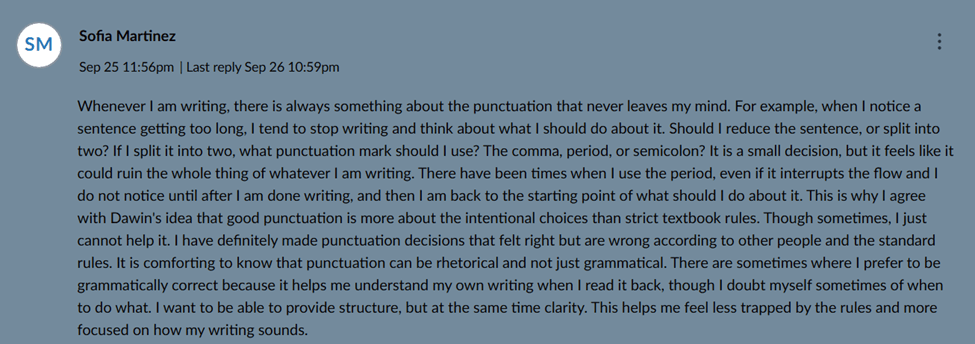
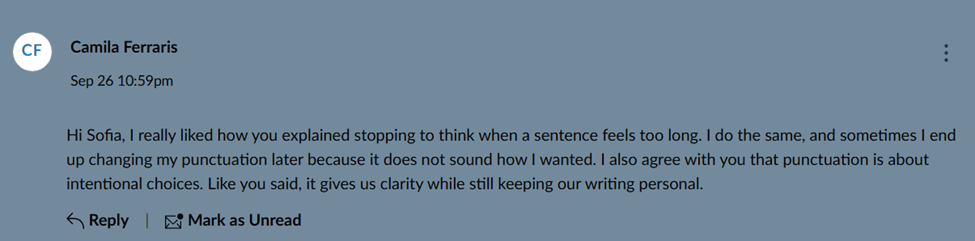
This activity was our first discussion forum, where we learned about the different ways punctuation works and reflected on our own punctuation habits. The prompt asked us to respond to questions about which punctuation system we use most, whether we’ve ever made a punctuation choice that “felt right,” and whether we agree that good writers don’t always follow strict handbook rules. After posting our response, we also had to reply to two classmates. For this portfolio, I included my reply to one of my classmates as evidence.
My classmate’s Initial Post:
My Reply:
Evidence #2
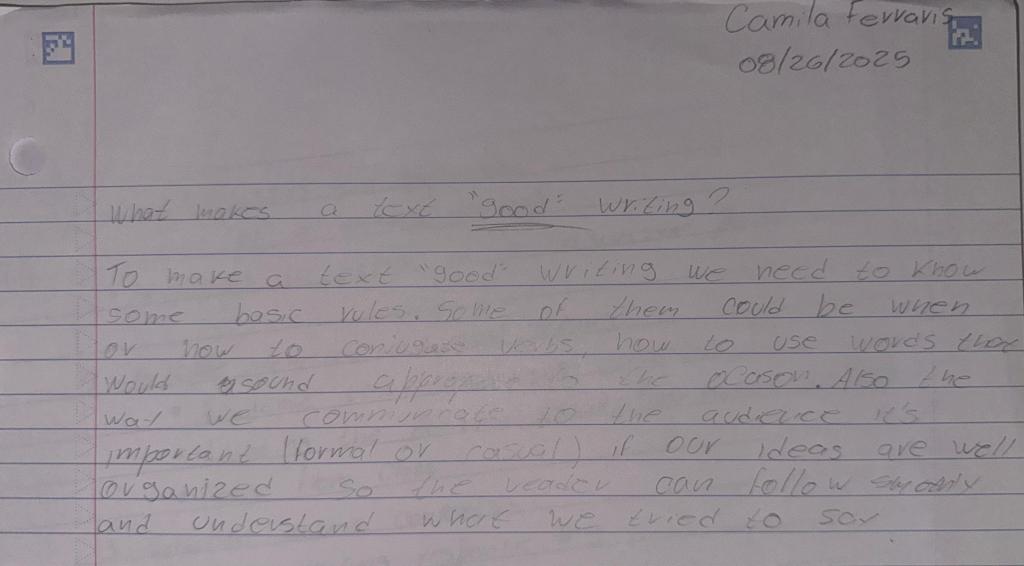
To establish a clear contrast with my other writing, a writing warm-up is a brief, timed exercise in which we respond immediately to a prompt provided by the teacher. Because these warm-ups are completed quickly, my sentences are often less connected, and I sometimes make grammatical errors or add notes in the margins as ideas occur. This spontaneous and unstructured style differs from Evidence One, which consists of a reply to a discussion post and is therefore more organized, and it contrasts even more strongly with Evidence Three, which is a complete essay and represents my most polished and developed writing.
Evidence #3
This evidence is my academic essay, Unlearning the Pattern: The Limits of the Five-Paragraph Essay, in which I critically examined the commonly taught five-paragraph essay structure. The assignment required me to research scholarly sources, analyze the purpose and limitations of the construct, and take a clear position supported by evidence. In this essay, I demonstrated my ability to plan, organize, and revise a formal, structured piece of writing while considering audience, purpose, and rhetorical choices. Compared to the discussion post in Evidence One or the informal writing warm-up, this essay reflects my most developed and polished writing, showing intentional decision-making in structure, clarity, and argumentation.
Conclusion
Across these three pieces of evidence, I demonstrate how I have met Outcome One by showing intentional engagement with different writing processes and the ability to adapt my writing to various contexts. In the timed writing warm-up, I practiced quick, spontaneous writing that required me to make immediate choices about ideas and punctuation, highlighting my ability to adapt under constraints. The discussion post allowed me to reflect on my own writing habits and engage with peers, showing how I can adjust my writing to communicate effectively in a more conversational, collaborative context. Finally, my academic essay demonstrates my capacity to plan, research, and revise a structured and formal piece of writing, making deliberate choices about organization, evidence, and argumentation. Together, these examples illustrate my growth as a writer, showing that I can flexibly adapt my writing processes to meet different goals, audiences, and purposes.
 Camila Ferraris Portfolio