Multiple Literacies & Goal Setting.
“Students will be able to demonstrate how they marshal/leverage their multiple literacies (e.g., speaking, listening, reading, multilingual writing, translating, multimodality, etc.) to support their writing processes.”
Evidence #1
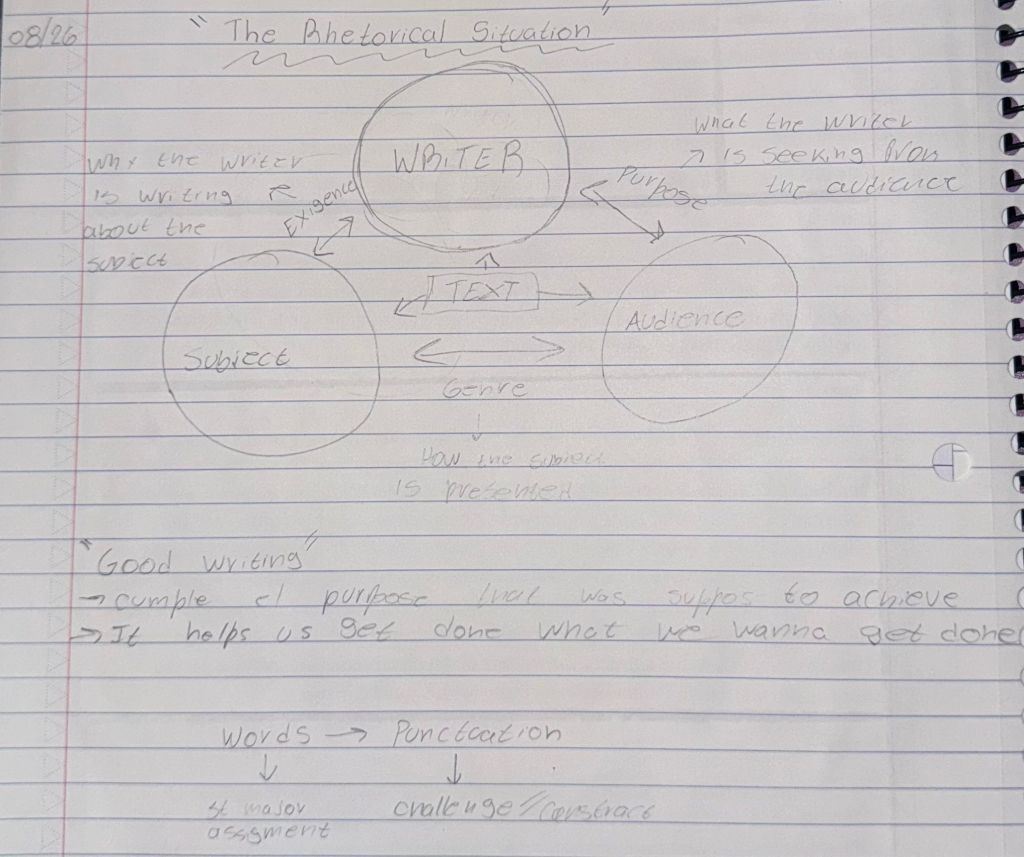
Understanding the rhetorical situation was one of the most important foundations for my work in this course, and my class notes helped me clearly break down how writing functions depending on the writer, the audience, the subject, and the purpose. In these notes, I mapped out how each element influences the choices a writer makes and how genre shapes the way a message is delivered. Studying these concepts showed me that effective writing depends on awareness, not just on following rules, because every writing task requires different decisions based on who will read it and what the writer wants to accomplish. I used what I learned from these notes throughout the semester to adjust my tone, structure, and approach in different assignments. By engaging with these ideas through listening, note-taking, and applying them to my own writing, I demonstrated my ability to use multiple literacies to analyze a writing situation and respond to it intentionally.
Evidence #2
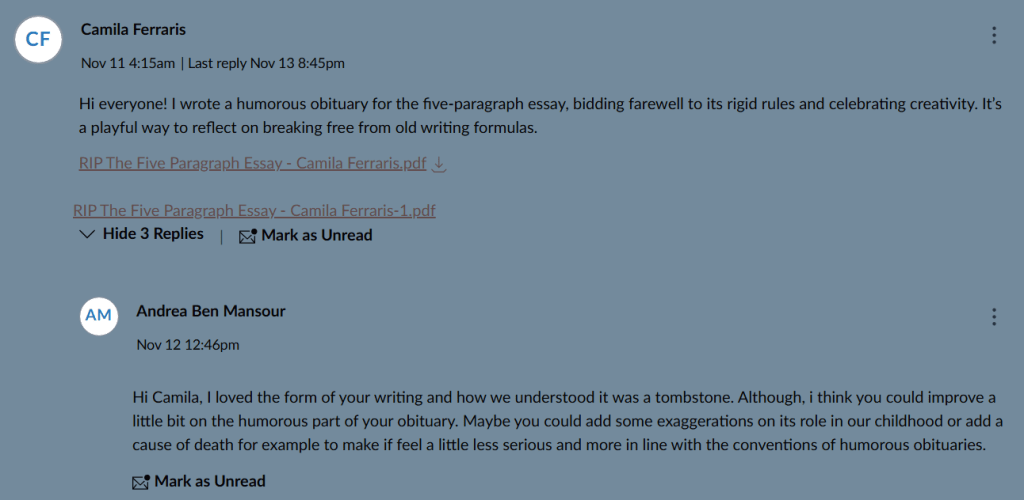
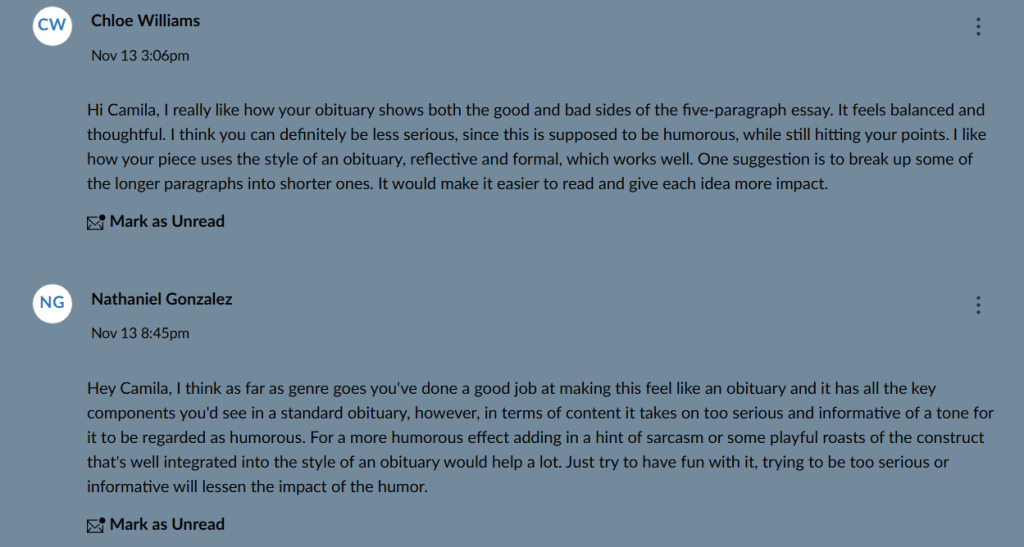
This activity was part of the “Adapting the Academic Essay: Genre Remix” project, where I transformed my original academic essay about the five-paragraph essay into a humorous obituary. The five-paragraph essay is a common structure taught in schools to help students organize ideas in an introduction, three body paragraphs, and a conclusion. For this assignment, I had to adapt my argument for a new audience and a creative genre, practicing rhetorical decision-making about tone, structure, and style. I shared my draft in a peer review discussion and received feedback from classmates and my instructor on how to improve humor, readability, and alignment with obituary conventions. I used these suggestions carefully, interpreting the feedback and applying multiple literacies such as reading, critical thinking, and reflective writing to revise my work and make meaningful improvements.
Conclusion:
By looking at both pieces of evidence together, it is clear how I met Outcome 2 through my ability to understand and respond to rhetorical situations. My class notes gave me the foundational knowledge I needed to break down the elements of the rhetorical situation and understand how writers make choices based on audience, purpose, genre, and context. I applied this understanding directly in my Genre Remix assignment, where I had to transform my original academic essay into an obituary that still communicated my argument while fitting the expectations of a completely different audience and genre. Using what I learned from my notes helped me shape my tone, structure, and style in a way that matched the rhetorical demands of the assignment. The feedback I received in peer review also helped me refine my decisions, showing that I can interpret and apply information from others to strengthen my work. Together, these evidences show that I can analyze a writing situation, determine what choices are appropriate, and produce writing that fits its purpose and audience, which is exactly what Outcome 2 requires.
 Camila Ferraris Portfolio