Revision.
“Students will be able to negotiate differences in and act with intention on feedback from readers when drafting, revising, and editing their writing.”
Evidence #1
For this assignment, we were asked to write an academic essay that analyzed a writing construct. A writing construct is a rule or expectation that shapes the way students are taught to write, such as a specific structure or pattern that teachers often present as the “correct” way to organize ideas. The purpose of the assignment was to explain the construct clearly, examine why it exists, and evaluate how it affects writers. My first attempt at this assignment was titled “Breaking the Formula: How Paragraph Rules Can Silence Student Voices.” This draft did not meet the assignment expectations because I misunderstood the task. Instead of analyzing a writing construct, I focused too heavily on my personal struggles with writing. I described my feelings about structure and vocabulary, but I did not analyze an actual writing rule or explain its purpose. The essay lacked research, a clear argument, and a focused construct, so it earned an R score that required a complete revision.
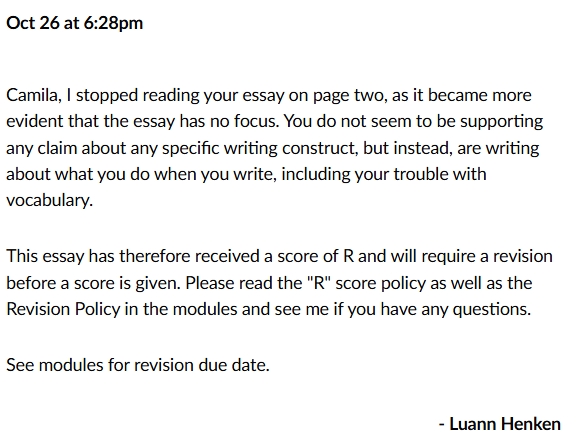
After meeting with my professor, I realized that my original essay needed major changes rather than small edits. Using her feedback, I created my revised essay titled “Unlearning the Pattern: The Limits of the Five-Paragraph Essay.” In this new version, I clearly centered my analysis on the five-paragraph essay as a writing construct. I explained what the five-paragraph essay is, why it is taught, how it benefits beginner writers, and how it can become limiting as writers grow. I replaced personal storytelling with research-based explanation, showing how the construct works within writing instruction and why it should be reconsidered. By shifting the entire purpose of my essay toward a researched academic argument, my revised draft met the expectations of the assignment and demonstrated a deeper understanding of writing constructs.
This process shows how I met Outcome 6. I used multiple literacies by reading academic materials about writing, interpreting my professor’s feedback, and applying that information to redesign my essay. I gathered information, evaluated its relevance, and used it purposefully to support an academic argument. Instead of simply editing grammar or sentences, I engaged in true revision by changing the focus, organization, and content of my essay. I transformed an unfocused personal narrative into a clear, researched, and analytical piece of academic writing. This demonstrates my ability to use information effectively for a specific audience and purpose, which is exactly what Outcome 6 requires.
 Camila Ferraris Portfolio